


We all know the statistic that 80% of day traders lose money, and most blow up their accounts within the first year. How about we stop all the nonsense and get to work on what we REALLY need to do to be successful?
Professional traders assess their performance weekly, daily, and even intraday. You should assess every trade and figure out what you did well and what you could have done better. This can stop a snowball of bad habits and get you to consistency faster.
The successful traders aren’t necessarily smarter – they just avoided the same critical mistakes over and over again. These aren’t small hiccups; these are account-killing errors that can wipe out months of progress in a single session.
Trading Without a Solid Plan or Strategy
Going into day trading without a plan is like performing surgery with a butter knife.
The harsh reality hit when I lost $2000 in a single morning trading my favorite futures contract with no exit plan.
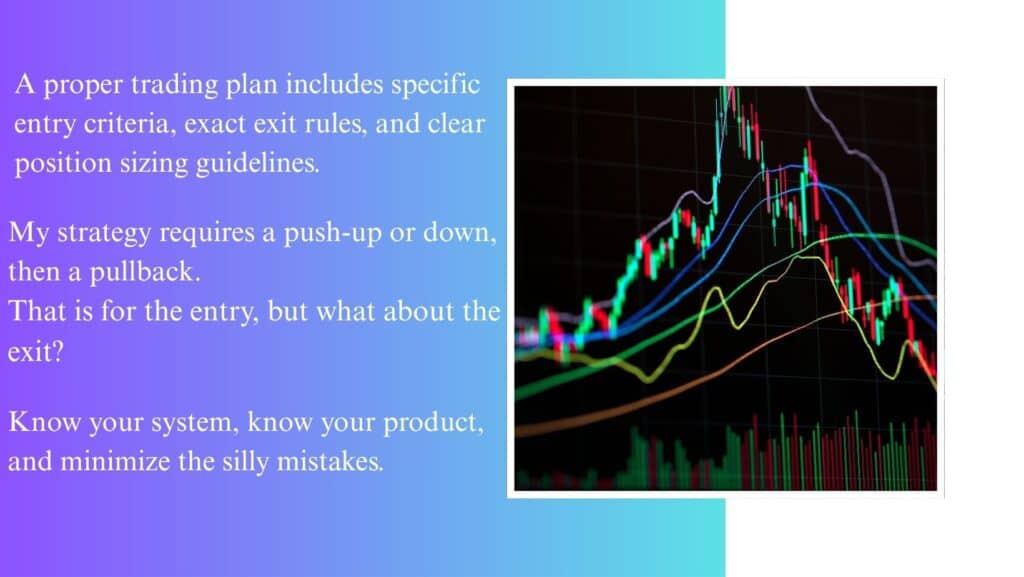
Here’s what separates winners from losers: first, having a plan, then actually following your plan when emotions run high. I can’t tell you how many times I’ve ignored my rules because I “had a feeling” about a trade. Those feelings usually cost me money.
You can have the most detailed plan in the world, but if you abandon it when stressed, you’re setting yourself up for failure.
Poor Risk Management and Position Sizing
I’ve talked a bit about dynamic position sizing before.
It is pretty much just adjusting the size of a trade based on what you’re seeing in the charts, or how confident you are in the setup.
Your account size will likely be a considerable factor.
You don’t want to risk it all on one trade. Without sounding like everybody else, no one trade should indeed make or break you.
Revenge Trading and Emotional Decision Making
Revenge trading – the silent account killer! It always happens at that moment that you know you can walk away and it won’t hurt too much, but instead of stepping away, we decide that the market “owed me” and started throwing larger positions at risky setups.
Your brain treats trading losses like physical pain, triggering fight-or-flight responses. The problem is, fighting back against the market usually means making bigger, stupider trades.
I developed techniques for emotional discipline.
- First, daily loss limits – if I lose more than $400, I’m done trading. I don’t leave this decision up to me either. My broker knows to cut me off at $400. However, if I’m losing like that, though, I stop way before hitting the limit.
- Second, I walk away after any loss greater than $200. The market will be there tomorrow, but your account might not be if you keep making emotional decisions.
One trick that’s helped me: After a trade, writing down why I entered and the thought process throughout the trade. If I can’t articulate some clear, logical reasoning, it’s probably a trade I shouldn’t have taken, and I need to re-evaluate.
Overtrading and Lack of Patience

New traders think more trades equal more money. In reality, it’s often the opposite.
I used to force trades just to feel like I was “working,” convincing myself bad setups were actually decent.
The costs of excessive trading go beyond losing money on bad setups. Commissions and fees, it all adds up.
Learning to identify quality setups versus forcing trades was crucial. I’m not saying now all the trades are perfect, but I’ve gotten better over time.
Quality setups check all your boxes: clear patterns, good volume, favorable risk-reward, and most importantly, it’s part of your plan.
When I was starting out, I would set daily trade limits – maximum five trades per day, regardless of how many “amazing” setups I saw.
This forces extreme selectivity and helps develop discipline. Some of my best days involved only two trades, while my worst typically involved eight or more.
Inadequate Capital and Unrealistic Expectations
You need $25,000 just to qualify as a pattern day trader, but for futures, you need less, just enough to cover initial margin on a contract.
Checking today, it’s about $2360 to trade one contract on the ES.
When undercapitalized, every trade becomes do-or-die because you need huge gains just to make meaningful dollars.
My realistic expectations for new traders? Aim for 1-2% monthly returns while learning.

Sounds small, but right now, you shouldn’t be aiming for huge wins, you should be aiming for consistency.
The compounding effect is where magic happens. A 2% monthly return turns $50,000 into over $80,000 in two years. Undercapitalization leads to desperate decisions – holding losers too long, cutting winners short, and taking stupid risks.
Neglecting Record Keeping and Trade Analysis

Record keeping and journaling aren’t sexy, but it’s critical. My journal includes my reasoning behind the trade, market conditions, liquidity, and lessons learned.
I track win rate, average win versus loss, maximum drawdown, and which setups consistently make money. Studying losing trades teaches more than celebrating winners.
Funny enough, when we lose, we tend to blow off our all-important journaling, but that is when it’s most important.
Data revealed I trade better in mornings versus afternoons, perform worse on Mondays, and my best trades I’m in and out of in seconds, not minutes.
Conclusion
Successful day trading isn’t about perfect strategies or magical market insights. It’s about consistently avoiding major mistakes and learning from every experience.
These six mistakes – no plan, poor risk management, revenge trading, overtrading, unrealistic expectations, and not collecting that juicy data – cause 90% of failures. The good news? They’re all preventable.
You’ll learn these lessons, the easy way or the hard way. Probably the latter, because that’s just how it goes. If it were easy, everyone would do it.
Focus on taking small bites out of the market rather than going for home runs, and avoid costly mistakes.
I’d love to hear your trading experiences! Share which mistakes resonated most or tell us about other costly errors you’ve discovered.